

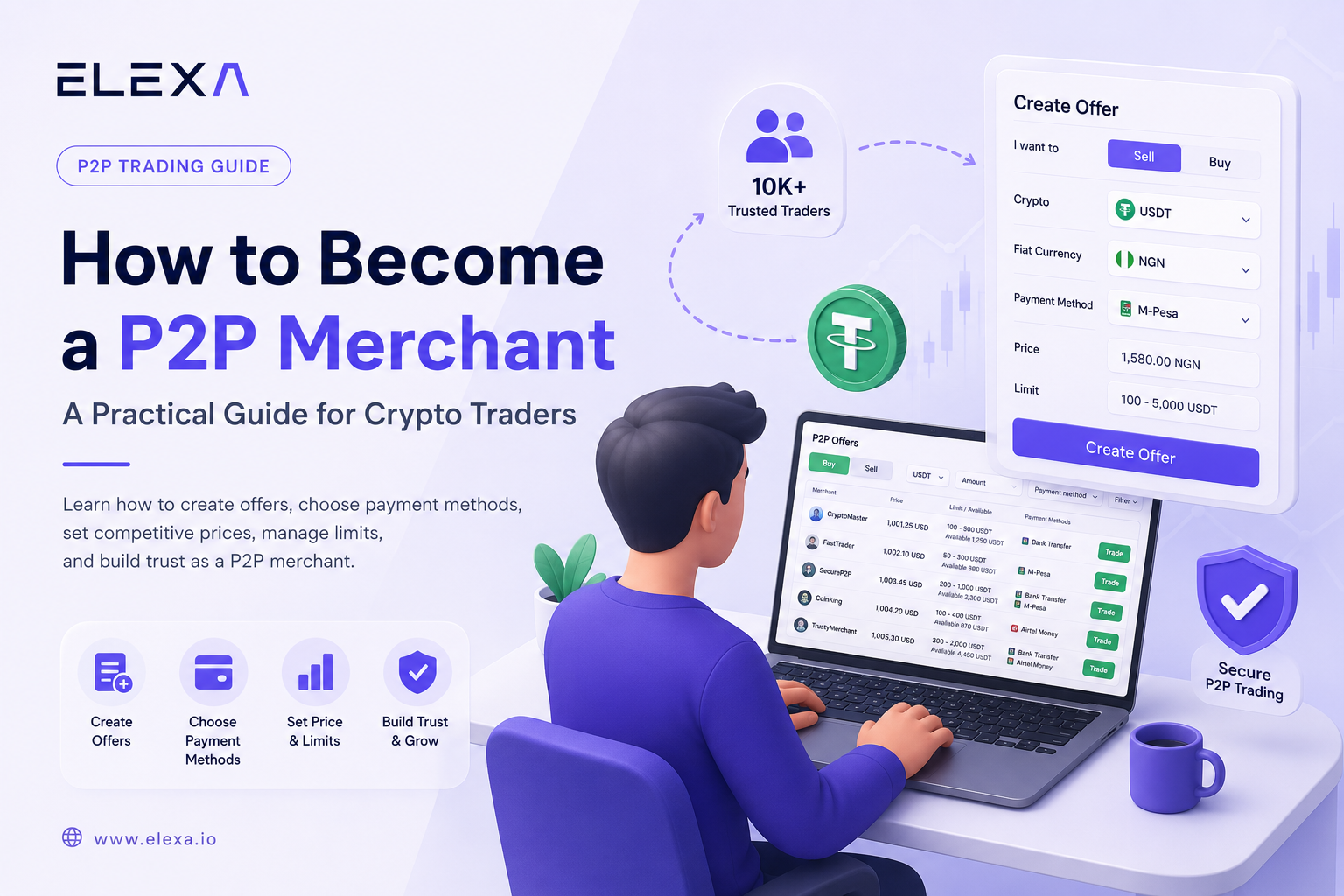
How to Become a P2P Merchant: A Practical Guide for Crypto Traders
Answer First
A P2P merchant is a crypto trader who regularly creates buy or sell offers, provides liquidity to other users, accepts local payment methods, and completes trades through a P2P marketplace.
To become a P2P merchant, you need to understand how P2P trading works, choose the right crypto asset, select payment methods, set competitive prices, define trade limits, write clear offer terms, and build trust through consistent trading behavior.
Most P2P merchants start with USDT because it is widely used, easier to price, and popular in local crypto markets. They usually earn from the spread between their buy and sell prices, but profit is not guaranteed. A merchant also needs to manage payment verification, liquidity, fees, user communication, and trade risk.
If you want to start as a P2P merchant, the best approach is simple:
- Start with one crypto asset, usually USDT
- Choose one or two payment methods you understand well
- Create small trade limits at first
- Write clear offer terms
- Respond quickly
- Track every trade
- Build reputation slowly
- Improve prices and limits over time
A good P2P merchant is not only someone with crypto balance. A good merchant is reliable, clear, fast, and easy to trade with.
Introduction
P2P crypto trading is not only for users who want to buy or sell crypto once.
For many traders, it can become a regular trading activity.
Some users create offers every day. Some provide USDT liquidity in their local market. Some accept bank transfers, mobile money, digital wallets, or local payment apps. Some help buyers get crypto faster. Others help users sell crypto and receive local currency.
These regular traders are often called P2P merchants.
Becoming a P2P merchant can be useful for people who already understand crypto, local payment methods, and buyer-seller behavior. Instead of waiting for available offers, merchants create their own offers and control their price, payment methods, trade limits, and terms.
This makes P2P merchant activity attractive for users who want more control over their trading.
But being a merchant is also a responsibility.
You need to manage payments carefully, verify transactions, communicate clearly, avoid unclear terms, and build a profile that other users can trust.
This guide explains what a P2P merchant is, how P2P merchants work, how they make money, what payment methods matter, how to create better offers, and how beginners can start more carefully.
If you want to explore direct P2P crypto trading, you can visit Elexa and review how offers, payment methods, and local trading options work.
What Is a P2P Merchant?
A P2P merchant is a user who regularly buys or sells crypto through a P2P marketplace by creating offers for other users.
Unlike a casual trader, a merchant usually trades more often and manages offers more actively.
A P2P merchant may:
- Buy USDT from users
- Sell USDT to users
- Accept local currency payments
- Support multiple payment methods
- Create offers with specific prices
- Set minimum and maximum trade limits
- Write trade terms
- Respond to buyers and sellers
- Build a trading profile
- Manage liquidity and payment accounts
In simple terms, a P2P merchant provides liquidity to the marketplace.
When users want to buy or sell crypto, merchants help make those trades possible.
How P2P Merchants Make Money
P2P merchants usually make money from the difference between buy and sell prices. This difference is called the spread.
For example, a merchant may buy USDT at a lower local rate and sell it later at a higher local rate.
Buy price: 1 USDT = 100 local currency units
Sell price: 1 USDT = 103 local currency units
Gross spread: 3%
But the full spread is not always final profit.
Merchants also need to consider:
- Payment method fees
- Transfer costs
- Platform fees if any
- Crypto withdrawal fees
- Currency conversion costs
- Failed or delayed trades
- Time spent managing trades
- Liquidity stuck in open orders
- Mistakes or unclear payment confirmations
This is why merchant activity should be treated like a real trading operation.
For a deeper explanation, read our guide on how P2P crypto traders make profit.
Why USDT Is Popular for P2P Merchants
USDT is one of the most common assets in P2P trading.
Many merchants start with USDT because it is widely recognized and usually easier for buyers and sellers to understand.
USDT is popular in P2P markets because:
- Many users search for it
- It is commonly used for local crypto trading
- It is easier to price than volatile assets
- It is widely accepted across marketplaces
- Buyers often prefer it for stability
- Sellers often use it to cash out into local currency
A merchant can create USDT buy offers, USDT sell offers, or both.
For example:
- Buy USDT from users who want local currency
- Sell USDT to users who want crypto
- Support specific payment methods
- Adjust price based on local demand
USDT is not the only possible asset, but it is often the easiest starting point for P2P merchants.
What You Need Before Becoming a P2P Merchant
Before creating merchant offers, you should prepare a few things.
1. Basic Understanding of P2P Trading
You should understand how P2P trading works before acting as a merchant.
This includes:
- How offers work
- How payment methods work
- How trade limits work
- How payment confirmation works
- How buyer and seller profiles work
- How platform rules work
- Why communication should stay inside the platform
A merchant should not learn the basics with large trades.
Start small and understand the flow first.
2. Crypto Balance
If you want to sell crypto, you need available crypto balance.
For example, if you create a USDT sell offer, you need enough USDT to complete trades.
If you want to buy crypto from users, you need enough local currency balance in your payment account.
3. Local Payment Method Access
Payment methods are one of the biggest parts of P2P trading.
You should choose methods you can verify clearly.
Common payment methods include:
- Bank transfer
- Mobile money
- Digital wallets
- Local payment apps
- Cash deposit
- Regional payment systems
For more detail, read our guide on best payment methods for P2P trading.
4. Time to Respond
P2P trading requires availability.
If your offer is active and a user starts a trade, you should be ready to respond.
Slow response can reduce trust, delay trades, and hurt your profile.
5. Clear Rules
Before creating an offer, decide your rules.
For example:
- Which payment methods do you accept?
- Do you accept third-party payments?
- What is your payment time limit?
- What proof of payment do you require?
- What is your minimum trade amount?
- What is your maximum trade amount?
Clear rules help avoid confusion.
How to Become a P2P Merchant Step by Step
Step 1: Choose Your Crypto Asset
Start with one asset.
For most beginners, USDT is usually the simplest option because it is widely used in P2P trading.
Avoid managing too many assets at the beginning.
When you start with one asset, it is easier to track:
- Price
- Balance
- Demand
- Profit
- Payment method performance
- User behavior
Step 2: Choose Your Local Currency
Choose the local currency you want to trade with.
This should match the country or market you understand.
For example, a merchant may create offers for:
- Kenyan shilling
- Nigerian naira
- Turkish lira
- Pakistani rupee
- Philippine peso
- Ghanaian cedi
- Other supported local currencies
Local currency demand can change from country to country. A good merchant understands the local market they are trading in.
Step 3: Choose Payment Methods
Do not accept every payment method at the beginning.
Start with one or two methods you understand well.
For example:
- Bank transfer
- M-Pesa
- Mobile money
- Digital wallet
- Local payment app
If you trade in a mobile-money market, a method like M-Pesa may be useful when available.
The best payment method is not always the fastest one. It is the one you can verify clearly and use consistently.
Step 4: Study Existing Offers
Before creating your own offer, study the marketplace.
Look at:
- Buy prices
- Sell prices
- Trade limits
- Payment methods
- Merchant profiles
- Offer terms
- Response behavior
- Local currency demand
This helps you understand what users expect.
Do not copy blindly. Use the market as a reference.
Step 5: Set Your Price
Pricing is one of the most important merchant skills.
Your price should be competitive, but it should also leave enough margin after costs.
When setting a price, consider:
- Current market rate
- Competitor offers
- Payment method demand
- Local currency demand
- Your fees and costs
- Trade size
- Your available balance
- Your desired margin
- Your reputation level
If you are new, avoid extreme prices.
A very high sell price may get no buyers. A very low buy price may get no sellers. A very aggressive price may bring too many trades before you are ready.
Start realistic, then adjust slowly.
Step 6: Set Trade Limits
Trade limits control the minimum and maximum amount users can trade with you.
For beginners, smaller limits are better.
Example:
Minimum trade amount: 20 USDT
Maximum trade amount: 200 USDT
As you gain experience, you can increase limits.
Trade limits should match:
- Your liquidity
- Payment method limits
- Your available time
- Your confidence level
- Market demand
- Payment verification process
Do not set limits higher than you can comfortably manage.
Step 7: Write Clear Offer Terms
Offer terms are the instructions users see before trading with you.
Good terms reduce confusion and help both sides follow the correct process.
Example:
Please use only the selected payment method.
Payment must come from your own account.
Send the exact amount shown in the trade.
After payment, follow the platform trade flow.
Do not request off-platform communication.
Clear terms are especially important for merchants because they trade more often.
For a full guide, read how to create a P2P offer.
You can also Create an Offer on Elexa when you are ready to set your own price, limits, and payment methods.
How to Build Trust as a P2P Merchant
Trust is one of the most valuable assets for a P2P merchant.
Users often choose merchants based on more than price.
They may check:
- Completed trades
- Completion rate
- Profile history
- Feedback
- Response time
- Verification level if available
- Offer clarity
- Payment method reliability
To build trust, focus on consistency.
Respond Quickly
Fast response improves the trading experience.
If you cannot respond, pause or adjust your offer.
Use Clear Terms
Do not write confusing instructions.
Simple terms are better than long, unclear rules.
Complete Trades Professionally
Stay polite, direct, and calm.
Even small trades affect your profile.
Avoid Unnecessary Cancellations
Too many cancellations can reduce trust.
Only keep offers active when you are available.
Keep Records
Track payment confirmation, trade IDs, amounts, fees, and results.
Good records help you manage your merchant activity better.
Buyer-Facing vs Seller-Facing Merchant Offers
P2P merchants may create different types of offers.
Sell Offers
A sell offer means you are selling crypto to buyers.
Example:
You sell USDT.
Buyer pays you local currency.
This is useful when users in your market want to buy USDT.
Buy Offers
A buy offer means you are buying crypto from sellers.
Example:
User sells USDT.
You pay local currency.
This is useful when users in your market want to cash out crypto.
Some merchants do both.
They buy USDT from users at one price and sell USDT to other users at another price.
This is how they may earn from spread.
How Payment Methods Affect Merchant Success
Payment methods can directly affect how many trades you receive.
Some methods are fast but may have lower limits. Some are slow but better for larger trades. Some are popular in specific countries. Some may require more careful verification.
A merchant should choose payment methods based on:
- Local popularity
- Speed
- Verification clarity
- Fees
- Transfer limits
- User demand
- Risk level
- Personal experience
For example, bank transfer may be useful for larger trades, while mobile money may be more practical for smaller or faster trades in some markets.
A merchant who understands local payment behavior has a stronger advantage.
Common Mistakes New P2P Merchants Make
Mistake 1: Starting With Large Trade Limits
Large limits can create pressure and increase complexity.
Start small.
Mistake 2: Accepting Too Many Payment Methods
More payment methods may bring more users, but they also bring more operational work.
Start with methods you know.
Mistake 3: Ignoring Fees
A spread may look profitable, but fees can reduce or remove profit.
Track all costs.
Mistake 4: Writing Poor Offer Terms
Unclear terms create confusion and slow trades.
Mistake 5: Leaving Offers Active While Offline
If you are not available, users may start trades and wait too long.
This can hurt your reputation.
Mistake 6: Choosing Price Over Trust
Some users only chase price. Good merchants focus on reliability and long-term profile growth.
Mistake 7: Not Tracking Trades
If you do not track every trade, you may not know whether your activity is actually profitable.
For more beginner mistakes, read our guide on common P2P trading mistakes.
Simple P2P Merchant Checklist
Before creating your first offer, check this list:
- Do I understand the P2P trading flow?
- Have I chosen one crypto asset?
- Have I chosen one local currency?
- Do I understand my payment method?
- Can I verify payments clearly?
- Have I checked competitor offers?
- Have I calculated possible fees?
- Are my trade limits small enough?
- Are my offer terms clear?
- Am I available to respond?
- Do I have a way to track trades?
If the answer is yes, you are more prepared to create your first offer.
How Beginners Should Start
If you are new, do not try to become a high-volume merchant on day one.
Start with a simple setup.
Example beginner setup:
Asset: USDT
Offer type: Sell USDT
Payment method: Bank transfer
Minimum trade: 20 USDT
Maximum trade: 100 USDT
Goal: Learn the flow and build profile history
After a few successful trades, you can adjust:
- Price
- Limits
- Payment methods
- Offer terms
- Availability
- Trade size
This slow approach helps you learn without taking too much pressure at once.
Is Becoming a P2P Merchant Profitable?
It can be profitable, but profit is not guaranteed.
A merchant’s result depends on:
- Market demand
- Spread
- Competition
- Payment methods
- Fees
- Trade volume
- Liquidity
- Reputation
- Response speed
- Local currency conditions
- Operational discipline
P2P merchant activity is not passive income.
It requires attention, clear processes, and careful payment verification.
A good merchant thinks long-term.
The goal is not only to complete one trade. The goal is to build a reliable trading profile that users want to trade with again.
Why Use Elexa as a P2P Merchant?
A P2P merchant needs a marketplace where users can create offers, compare payment methods, and trade directly with other users.
Elexa is built for P2P crypto trading with local currencies, multiple payment methods, and user-created offers.
For merchants, offer creation is especially important because it gives more control over:
- Price
- Crypto asset
- Local currency
- Payment method
- Trade limits
- Offer terms
- Trading availability
Instead of only accepting existing offers, merchants can create their own trading conditions.
When you are ready, you can Create an Offer and start building your P2P trading profile.
FAQ
What is a P2P merchant?
A P2P merchant is a trader who regularly creates buy or sell offers on a P2P marketplace and provides liquidity to other users.
How do P2P merchants make money?
P2P merchants usually make money from the spread between buy and sell prices. However, profit is not guaranteed and costs must be included.
Is USDT good for P2P merchants?
USDT is commonly used in P2P trading because many users understand it and it is widely used in local crypto markets.
Do I need a lot of money to become a P2P merchant?
Not necessarily. Beginners can start with small trade limits and increase slowly as they gain experience.
What payment methods should P2P merchants use?
Merchants should use payment methods they understand and can verify clearly, such as bank transfer, mobile money, digital wallets, or local payment apps.
How do I create a P2P offer?
You choose the crypto asset, local currency, price, payment method, trade limits, and offer terms. You can read our guide on how to create a P2P offer.
What is the best trade limit for a new merchant?
New merchants should start with small limits, such as 20–100 USDT, depending on their market and comfort level.
Is P2P merchant profit guaranteed?
No. Profit depends on pricing, payment methods, market demand, costs, competition, and merchant discipline.
How can I build trust as a P2P merchant?
Respond quickly, complete trades professionally, use clear terms, avoid unnecessary cancellations, and keep your payment methods reliable.
Where can I start as a P2P merchant?
You can explore Elexa and Create an Offer to set your own price, payment method, and trade limits.
Conclusion
Becoming a P2P merchant is one of the most practical ways to move from casual crypto trading to more active marketplace participation.
A merchant creates offers, provides liquidity, accepts local payment methods, manages trade limits, and builds trust with other users.
But merchant activity is not just about having crypto balance.
You need clear pricing, reliable payment methods, fast response, good offer terms, careful payment verification, and proper trade tracking.
If you are new, start small. Choose one asset, one local currency, and one payment method. Keep your limits realistic. Write simple terms. Track every trade. Improve slowly.
A successful P2P merchant is not only someone who offers a good rate.
A successful merchant is someone users can understand, trust, and trade with smoothly.
Soft CTA
Explore Elexa to compare P2P crypto offers, local currencies, and available payment methods.
When you are ready to set your own price, payment method, and trade limits, you can Create an Offer and start building your P2P trading profile.
