

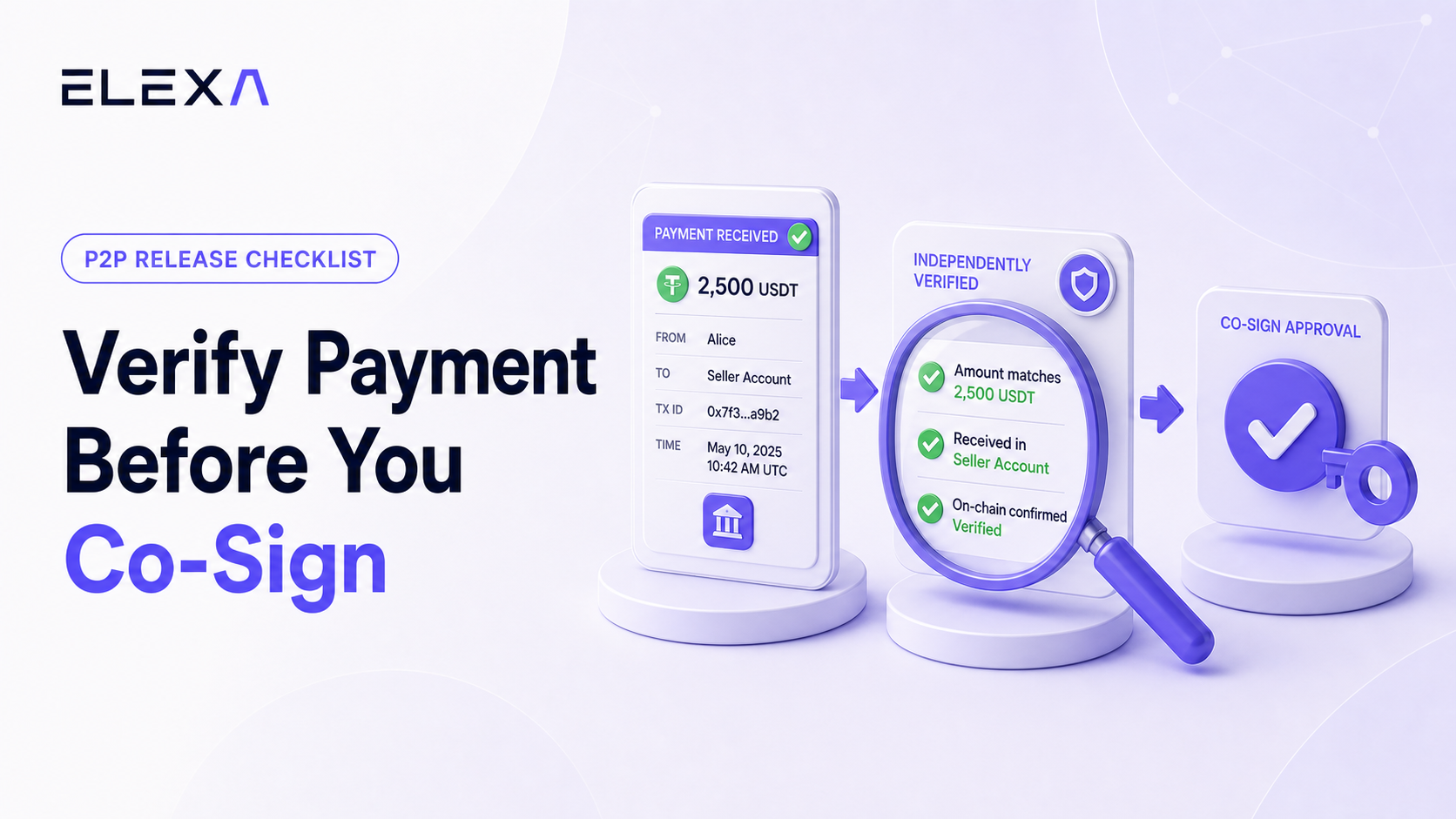
Before you co-sign a P2P crypto release, verify the payment inside the actual receiving account. A screenshot, text message, email, or “payment sent” notice is not final proof. Confirm that the correct amount and currency have reached the correct account, the payment status is complete and usable, and any required payer or reference details match the active trade. Only then should you approve the release.
This habit matters even more in Elexa’s shared-release model. A release requires two signatures: the exchange and the counterparty must both approve before the funds can move. If either required signature is missing, the funds are not released. That shared control is designed to reduce unilateral action, but it works best when every signer checks the underlying payment carefully.
Why payment verification matters before a P2P release
In a peer-to-peer trade, two different transfers are connected: a fiat or payment-method transfer on one side and a crypto release on the other. The release may be difficult to reverse, while a payment notification can be delayed, incomplete, misleading, or unrelated to the active order. That timing difference creates one of the most common P2P risks: releasing crypto before the payment is truly available.
Verification is therefore not a formality. It is the decision point that connects the payment you can independently confirm with the release you are being asked to co-sign. Elexa’s two-signature process adds a shared checkpoint, but it does not replace due diligence. Each required signer should evaluate the facts rather than relying on the other party’s message.
If you are new to the model, start with how Elexa’s two-signature release works. The key idea is simple: neither required party can complete the release alone.
What counts as real payment confirmation?
The strongest confirmation comes from the source of truth: the official app, website, statement, or on-chain record for the receiving account. Open that source yourself. Do not verify a transfer through an image or link supplied by the payer.
| Signal | What it may show | What it does not prove |
|---|---|---|
| Screenshot or PDF receipt | A transfer may have been initiated | That funds reached your account or are final |
| SMS or email notification | A payment service generated a message | That the message is authentic or the balance is usable |
| “Payment sent” status in chat | The counterparty says they completed their step | That your receiving account was credited |
| Pending transaction | A transfer is being processed | That settlement is complete or cannot fail |
| Credit visible in the official receiving account | Funds reached the selected destination | That every trade detail matches; verify amount, payer, and reference too |
A six-step payment verification checklist
1. Match the payment to the active Elexa trade
Open the active order and compare the asset, fiat currency, payment method, exact amount, counterparty, and order reference. Verify the current trade rather than relying on details copied from a previous conversation. Similar amounts or repeated counterparties can make an unrelated transfer look convincing at first glance.
2. Open the actual receiving account yourself
Sign in through the payment provider’s official app or website. Check the account that was specified for this order. Avoid links supplied in chat, and do not treat a screenshot as a substitute for your own account view. If the provider has a transaction-history page, open the individual transaction rather than checking only a notification banner.
3. Confirm the exact amount and currency
The credited amount should match the order. Watch for partial payments, split payments, unexpected fees, and a different currency. If the trade terms do not explicitly allow a variation, do not assume that “close enough” is acceptable. A small mismatch may create a larger reconciliation problem later.
4. Check that the payment is completed and available
Words such as pending, processing, scheduled, under review, or on hold mean you should wait. The balance and transaction detail should indicate that the funds are credited according to the payment method’s normal process. A visible transaction that is not yet usable is not the same as a completed payment.
5. Verify payer details and the payment reference when required
Some trade terms require the sender name, account identifier, or reference to match the counterparty or order. Check those fields exactly where the payment provider displays them. If a third party paid, the payer identity differs, or the reference is missing, pause and follow the trade’s stated process. Do not solve an identity mismatch through an informal promise in chat.
6. Co-sign only when every material detail aligns
Review the trade one final time: right order, right account, right amount, right currency, acceptable payer details, and completed status. If all required checks align, proceed with your signature. If one fact remains unclear, do not co-sign yet. Shared approval is useful precisely because it creates time for both required parties to confirm the same reality.
Payment-method-specific checks
Bank transfer
Use the bank’s official transaction history. Confirm the credited amount, value date or completed status, payer information where available, and the reference required by the order. A transfer instruction or remittance slip can be created before money reaches you, so it should not trigger release by itself.
Mobile money or digital wallet
Open the wallet directly and inspect the transaction record and available balance. Be cautious with cloned notifications and edited screenshots. Confirm the sender identifier, amount, currency, and status inside the service rather than through an external message.
On-chain payment when relevant
Check the correct network, asset, destination address, amount, transaction status, and the number of confirmations appropriate for the trade terms. A transaction hash alone is not enough if it points to the wrong network, address, asset, or amount. Network conditions vary, so follow the order’s stated confirmation requirement instead of assuming instant finality.
Red flags that should stop a release
- The counterparty provides only a screenshot, receipt, SMS, or email.
- The payment is pending, scheduled, reversible, held, or still processing.
- The amount, currency, sender, destination, or reference does not match.
- You receive several partial transfers when the order expected one payment.
- The counterparty pressures you to release quickly or claims an emergency.
- You are asked to move the conversation or evidence off the trading platform.
- A third party pays without the trade terms allowing it.
- You are asked to return an “extra” amount to a different account.
- The official receiving account shows no completed credit.
Pressure is not proof. A legitimate confirmation remains verifiable even if you take a few extra minutes to check it. For more examples, review these common P2P trading mistakes and the practical guide to buying USDT more carefully.
What to do when you are not sure
- Do not co-sign the release. An unanswered question is a reason to pause.
- Keep the evidence attached to the trade. Preserve transaction details, timestamps, order references, and relevant messages.
- Ask for clarification inside the platform. Keep a clear record and avoid switching to untracked channels.
- Use the available support or dispute process. Escalate when the payment cannot be independently verified or the details conflict.
- Do not send a separate refund impulsively. Resolve mismatches through the appropriate trade process before moving additional money.
You can also review Elexa’s trust information before trading. No process removes every risk, but a documented verification routine can reduce preventable mistakes and improve the quality of each release decision.
How two signatures add shared control
Traditional release flows may depend heavily on one party taking the final action. In Elexa’s updated model, the release requires approval from both the exchange and the counterparty. One required signer cannot release the funds alone, and if both do not sign, the release does not occur.
This structure creates a useful separation between a claim and a confirmed action. One party may report that payment was sent, but the other still has the opportunity to check the receiving account before approving. The model is intended to encourage shared control and reduce the risk of a premature unilateral release. It is not a promise that every trade will be risk-free; careful verification and clear trade records still matter.
Frequently asked questions
Is a bank receipt enough to co-sign a crypto release?
No. A receipt may indicate that a transfer was initiated, but it does not confirm that the correct funds are completed and available in your receiving account. Verify through your bank or payment provider directly.
What if the buyer says the payment is pending?
Wait. Do not co-sign while the payment is pending, processing, scheduled, or held. Continue only after the status and trade details meet the agreed requirements.
Can a screenshot be used as supporting evidence?
It can provide context, but it should not be your source of truth. Screenshots can be incomplete, unrelated, or altered. The official receiving account and transaction record should drive the release decision.
What happens if only one party signs in Elexa?
The funds are not released. The updated flow requires both designated signatures—the exchange and the counterparty—before release can proceed.
Does two-signature release guarantee a safe trade?
No system can guarantee that every trade is free of risk. Two signatures add shared control and reduce unilateral release risk, while users still need to verify payments, follow the order terms, and use the proper support process when something is unclear.
The takeaway: verify first, then co-sign
A careful P2P release is built on evidence, not urgency. Check the actual receiving account, match every material trade detail, confirm that the payment is completed, and sign only when the facts align. Elexa’s two-signature release gives both required parties a role in that decision, helping make control more shared and the release process more deliberate.
Ready to explore available offers? Visit the Elexa P2P marketplace and apply the checklist to every trade.
