

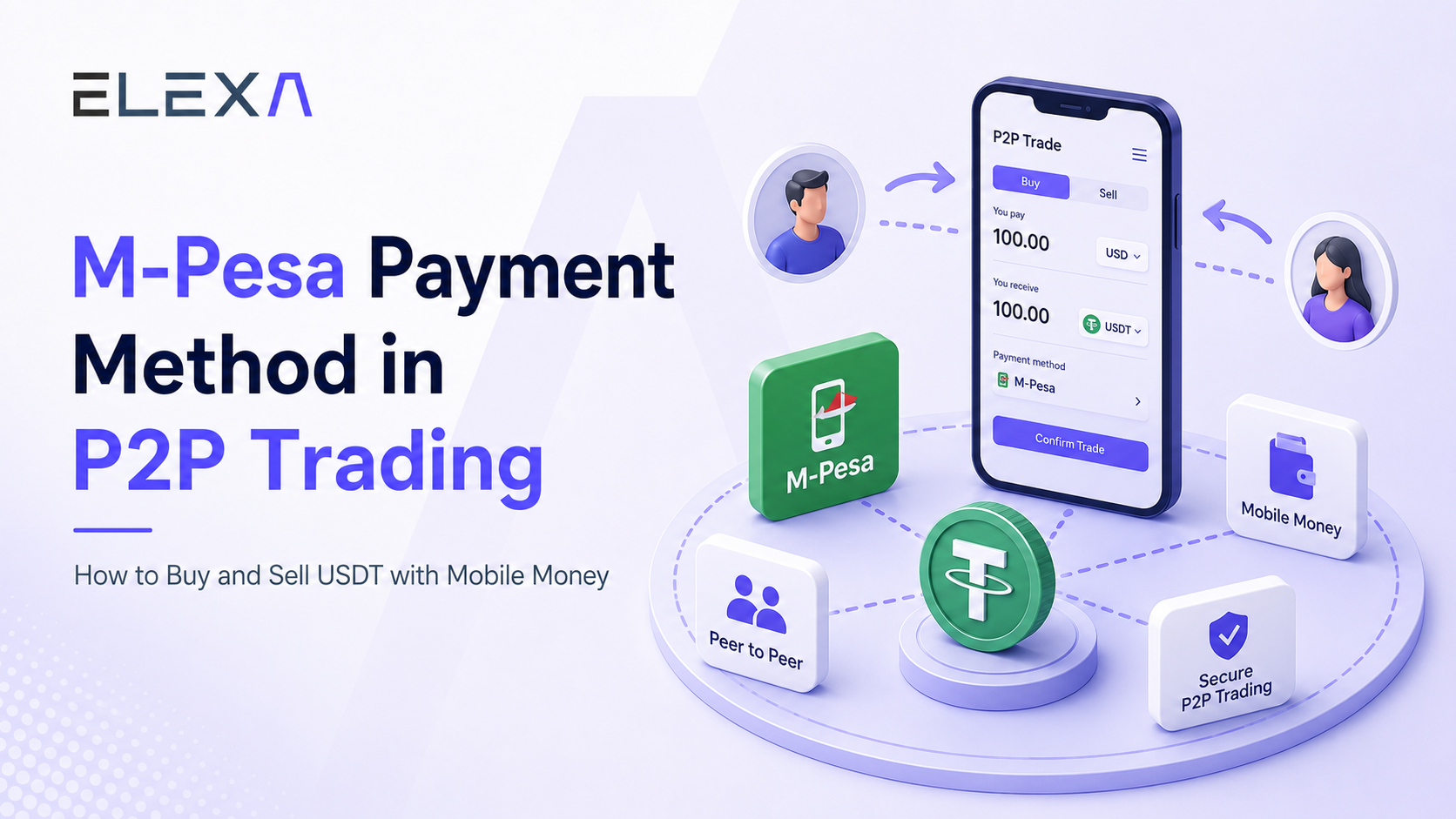
M-Pesa Payment Method in P2P Trading: How to Buy and Sell USDT with Mobile Money
Answer First
M-Pesa is one of the most popular mobile money payment methods in parts of Africa, especially in markets where users prefer fast local transfers over traditional bank payments. In P2P crypto trading, M-Pesa can be used as a local payment method for buying or selling USDT, depending on the marketplace, country, and available offers.
For buyers, M-Pesa can make it easier to pay a seller using mobile money. For sellers, it can be a convenient way to receive local currency quickly from a buyer. Because M-Pesa is widely used for money transfers, bill payments, merchant payments, and cash-in/cash-out services, it fits naturally into local P2P crypto markets. M-Pesa was launched in Kenya in 2007 by Vodafone and Safaricom and is commonly associated with mobile-based money transfer and payment services.
To use M-Pesa safely in P2P trading, users should always check the counterparty profile, verify payment details, keep proof of payment, avoid third-party transfers, and keep communication inside the platform.
Introduction
In many countries, crypto trading is not only about global exchanges, cards, or bank wires. Local payment methods matter.
A trader may want to buy USDT using the payment app they already use every day. A seller may want to receive local currency through a method that is fast, familiar, and easy to verify. This is why mobile money has become important in P2P crypto trading.
One of the best-known mobile money systems in Africa is M-Pesa.
M-Pesa allows users to send, receive, store, and spend money through a mobile phone. It became especially important in markets where many users rely on mobile-first financial services rather than traditional bank accounts.
For P2P traders, this creates a practical bridge between crypto and local money.
A user can buy USDT from another trader and pay through M-Pesa. Another user can sell USDT and receive local currency through M-Pesa. This makes the trading process more local, more accessible, and easier to understand for users who already trust mobile money.
This guide explains how M-Pesa works as a P2P payment method, why it matters for USDT trading, what buyers and sellers should check, and how to use it more carefully on a P2P marketplace like Elexa.
What Is M-Pesa?
M-Pesa is a mobile money service that allows users to move money through their phones. The name comes from “M” for mobile and “pesa,” which means money in Swahili. It started in Kenya and later expanded into several other markets. M-Pesa is commonly used for local transfers, withdrawals, deposits, merchant payments, bill payments, and other mobile financial services.
Unlike a traditional bank transfer, M-Pesa is usually built around a mobile wallet connected to a phone number. Users can send money to another user, pay a business, withdraw cash through agents, or receive funds directly into their mobile money account.
This makes M-Pesa especially useful in places where mobile payments are more common than cards or bank accounts.
For crypto users, M-Pesa can become a familiar payment option inside a P2P crypto marketplace.
Why M-Pesa Matters in P2P Crypto Trading
P2P trading works best when users can trade with payment methods they already understand.
In many African markets, mobile money is not a backup option. It is part of everyday financial life. Users may send money to family, pay merchants, receive business payments, or withdraw cash through mobile money agents.
This is why M-Pesa can be useful for P2P trading.
Instead of forcing users to rely only on bank transfers, a P2P marketplace can allow buyers and sellers to trade using local payment methods that already fit their habits.
M-Pesa can help users:
- Buy USDT with local currency
- Sell USDT and receive local currency
- Trade without relying only on traditional bank transfers
- Use mobile-first payment confirmation
- Access crypto through a familiar payment method
- Create offers for local buyers and sellers
For users who already use M-Pesa, buying or selling USDT through P2P trading may feel more natural than using unfamiliar payment channels.
How Buying USDT with M-Pesa Works
The exact process depends on the platform and the offer, but a typical P2P flow may look like this:
1. Choose USDT as the Crypto Asset
The buyer first chooses USDT as the cryptocurrency they want to buy.
USDT is widely used in P2P trading because many users see it as easier to understand than volatile crypto assets.
2. Select M-Pesa as the Payment Method
The buyer then looks for sellers who accept M-Pesa.
This is important because not every seller accepts every payment method. Some sellers may prefer bank transfers. Others may accept mobile money, digital wallets, or local apps.
3. Review the Seller Profile
Before starting the trade, the buyer should check the seller’s profile.
Important details include:
- Completed trades
- Rating or feedback
- Trade history
- Payment terms
- Response behavior
- Verification level if available
A good rate is helpful, but a reliable seller is more important.
4. Follow the Seller’s Payment Instructions
The buyer should read the offer terms carefully before sending money.
For M-Pesa payments, this may include:
- The correct recipient name
- The correct phone number or payment identifier
- The exact amount
- Required payment reference
- Whether third-party payments are allowed or not
The buyer should never guess payment details.
5. Send the M-Pesa Payment
After confirming the details, the buyer sends the local currency payment through M-Pesa.
The payment should match the offer amount exactly.
6. Keep Proof of Payment
The buyer should keep the payment confirmation message or screenshot.
This can be useful if the trade needs support review.
7. Complete the Trade Through the Platform
The buyer should follow the platform flow and avoid moving the trade outside the marketplace.
For more general safety tips, read our guide on How to Buy USDT Safely.
How Selling USDT with M-Pesa Works
Selling USDT with M-Pesa is the opposite side of the same process.
A seller offers USDT and receives local currency through M-Pesa.
A typical flow may look like this:
1. Create or Accept a Sell Trade
The seller can either accept an existing buyer request or create a sell offer.
Creating an offer gives the seller more control over price, payment method, limits, and terms.
2. Choose M-Pesa as an Accepted Payment Method
If M-Pesa is available as a payment method in the seller’s market, the seller can add it to the offer.
This tells buyers that they can pay through M-Pesa.
3. Set Clear Trade Limits
The seller should define minimum and maximum trade amounts.
For example:
Minimum trade amount: 20 USDT
Maximum trade amount: 500 USDT
Payment method: M-Pesa
Payment time limit: 15 minutes
Trade limits should match the seller’s liquidity, payment method limits, and ability to verify payments.
4. Write Clear Offer Terms
Offer terms are very important.
For M-Pesa trades, sellers should explain:
- Payment must come from the buyer’s own account
- The sender name should match the platform profile
- The exact amount must be sent
- Payment proof may be required
- Third-party payments are not accepted if that is the seller’s rule
- The buyer should not ask to trade outside the platform
A clear offer reduces confusion.
For more detail, read our guide on How to Create a P2P Offer.
Why Sellers Like M-Pesa in P2P Trading
M-Pesa can be attractive for sellers because it is fast and familiar in supported markets.
Fast Local Payments
Mobile money transfers can often be completed quickly, which makes them useful for P2P trades where timing matters.
Familiar User Experience
Many users already know how to send and receive money through M-Pesa. This reduces friction during the trade.
Useful for Smaller Trades
M-Pesa can be practical for smaller retail trades where users want a simple local payment method.
Mobile-First Access
Users do not always need a traditional banking flow to send or receive payment. This can make P2P trading more accessible.
Good Fit for Local Merchants
P2P merchants who understand M-Pesa can create offers for users who prefer mobile money.
What Buyers Should Check Before Paying with M-Pesa
Before sending an M-Pesa payment in a P2P trade, buyers should slow down and check the details.
Check the Seller’s Profile
Do not choose a seller only because the price looks attractive.
Review the profile, trade history, and terms.
Confirm the Payment Details
Make sure the M-Pesa number, name, and amount match the offer instructions.
Avoid Third-Party Details
If the seller gives payment details that do not match the account or seem unrelated, be careful.
Keep Payment Proof
Save the M-Pesa confirmation message or screenshot.
Do Not Trade Outside the Platform
If someone asks you to continue on another app or send payment outside the agreed process, do not continue.
For more mistakes to avoid, read Common P2P Trading Mistakes.
What Sellers Should Check Before Completing a Trade
Sellers should also verify everything carefully before completing a trade.
Confirm That Payment Has Arrived
Do not rely only on a screenshot. Check your own M-Pesa account or transaction history.
Check the Sender Name
The sender name should match the buyer’s expected identity or platform terms.
Check the Exact Amount
The payment amount should match the trade amount.
Check Payment Status
Make sure the payment is completed, not pending or reversed.
Keep Records
Save the confirmation details until the trade is fully completed.
Use Clear Terms
Clear terms protect both sides from confusion.
M-Pesa vs Bank Transfer in P2P Trading
Both M-Pesa and bank transfer can be useful, but they are not the same.
M-Pesa May Be Better When:
- The user prefers mobile money
- The trade size is small or medium
- The market uses mobile money heavily
- The buyer or seller wants a fast local payment method
- Bank access is limited or inconvenient
Bank Transfer May Be Better When:
- The trade size is larger
- Formal bank records are preferred
- The seller wants bank account confirmation
- The payment method requires more detailed records
The best payment method depends on the country, trade size, counterparty, and verification process.
For a broader comparison, read our guide on Best Payment Methods for P2P Trading.
Common Mistakes When Using M-Pesa for P2P Trading
Mistake 1: Sending Money Before Reading the Offer Terms
Always read the full terms before paying.
Mistake 2: Paying the Wrong Number
Double-check the recipient details before sending funds.
Mistake 3: Ignoring Sender Name Rules
If a seller requires payment from the buyer’s own account, follow that rule.
Mistake 4: Trusting Screenshots Alone
Sellers should verify the payment inside their own M-Pesa account.
Mistake 5: Trading Outside the Platform
Off-platform trades are harder to review and can create unnecessary risk.
Mistake 6: Choosing Offers Only by Rate
A good price does not always mean a good trade. Profile quality matters.
Mistake 7: Not Keeping Evidence
Both buyers and sellers should keep proof of payment and trade details.
How to Write Good M-Pesa Offer Terms
If you are creating a P2P offer that accepts M-Pesa, your terms should be simple and direct.
Here is an example:
M-Pesa payments only.

Please send payment from your own M-Pesa account.

The sender name must match your platform profile.

Send the exact amount shown in the trade.

After payment, mark the trade as paid and upload proof if needed.

Do not request off-platform communication or payment changes.
Good terms help buyers understand what to do and help sellers avoid unclear payments.
Is M-Pesa Good for Buying and Selling USDT?
M-Pesa can be a good payment method for P2P USDT trading when both sides understand how it works.
It is especially useful in markets where mobile money is already trusted and widely used.
However, users should not treat any payment method as automatically safe. The quality of the trade still depends on:
- Counterparty profile
- Offer terms
- Payment verification
- Platform rules
- Trade evidence
- User behavior
M-Pesa can make payment easier, but careful trading habits still matter.
Using M-Pesa on a P2P Marketplace
A P2P marketplace helps organize the trade between buyer and seller.
Instead of finding someone randomly, users can compare offers, review profiles, choose payment methods, and follow a structured trading process.
On Elexa, users can explore direct P2P crypto trading and create offers based on available payment methods, local currency needs, and trading preferences.
For users who want to sell crypto and receive local money, payment methods like M-Pesa can be especially useful when available in their market.
For sellers and merchants, the ability to Create an Offer helps them define their price, trade limits, payment method, and terms.
FAQ
What is M-Pesa?
M-Pesa is a mobile money service that allows users to send, receive, deposit, withdraw, and spend money through a mobile phone. It started in Kenya and became one of the best-known mobile money services in Africa.
Can I buy USDT with M-Pesa?
Yes, if a P2P marketplace has sellers who accept M-Pesa in your country. You need to choose an offer that supports M-Pesa and follow the seller’s payment instructions.
Can I sell USDT and receive M-Pesa?
Yes, if buyers in your market support M-Pesa payments. Sellers can create or accept offers where M-Pesa is used as the payment method.
Is M-Pesa a bank transfer?
No. M-Pesa is a mobile money service, not a traditional bank transfer. Users typically send and receive funds through a mobile wallet linked to their phone number.
Is M-Pesa good for P2P trading?
M-Pesa can be useful for P2P trading because it is fast, familiar, and widely used in supported markets. However, users should still verify payments carefully and follow platform rules.
What should I check before using M-Pesa in a P2P trade?
Check the buyer or seller profile, payment details, offer terms, sender name, exact amount, and payment confirmation.
Should I accept third-party M-Pesa payments?
It is usually better to avoid third-party payments unless the platform and offer terms clearly allow them. Third-party payments can make verification more difficult.
What proof should I keep after paying with M-Pesa?
Keep the payment confirmation message, transaction ID, screenshot, and any relevant trade details.
Can merchants create M-Pesa offers?
Yes, if the marketplace supports M-Pesa in their market. Merchants can create offers with M-Pesa as a payment method and define their own limits and terms.
Where can I learn more about P2P payment methods?
You can read this guide on Best Payment Methods for P2P Trading.
Conclusion
M-Pesa is one of the most important mobile money payment methods for local digital payments in parts of Africa.
For P2P crypto traders, it can be a practical way to buy USDT with local currency or sell USDT and receive local money.
Its main strength is familiarity. Many users already understand how M-Pesa works, which makes it easier to use in a P2P trading flow.
But a familiar payment method does not remove the need for careful trading.
Buyers should check seller profiles, payment details, and offer terms before sending money. Sellers should verify payment inside their own account before completing a trade. Both sides should keep proof and avoid off-platform deals.
When used carefully, M-Pesa can be a useful payment method for local P2P USDT trading.
Soft CTA
Explore Elexa to find P2P crypto offers, compare available payment methods, and trade directly with other users.
If you are a seller or merchant, you can Create an Offer, set your own trade limits, choose your payment method, and build your P2P trading profile.
